

Attracting more patients to your dental practice requires a structured digital marketing strategy focused on visibility and conversion tracking. You need to show up when people are searching for your services and make it incredibly easy for them to book an appointment. Here are exactly seven actionable strategies you can implement right now to grow your patient base:
- Google Business Profile (GBP): Claiming and optimizing your GBP ensures you appear in the Local Pack for searches like "dentist near me." You must add accurate services, high-quality photos, and consistently manage reviews to build trust.
- Google Ads: Running targeted search campaigns captures patients actively looking for high-value treatments like dental implants or emergency care. You are putting your practice at the very top of the search results for ready-to-book patients.
- Service-Specific Landing Pages: Directing paid traffic to dedicated landing pages drastically increases conversion rates. Never send paid ad traffic to your generic homepage; always send it to a page tailored to the specific ad they clicked.
- Local SEO: Optimizing your website for local search ensures you rank organically. Focus on generating consistent reviews, matching your Name, Address, and Phone number (NAP) across directories, and building pages for each specific service.
- Social Media Ads: Facebook and Instagram campaigns allow you to target specific local demographics. You can use geo-targeting and engaging video content to generate demand for cosmetic and general dentistry within a 10-mile radius.
- Patient Referral Programs: Incentivizing your current patients to refer friends and family drives the lowest-cost, highest-quality leads. Small incentives like service credits can generate consistent organic growth.
- Targeted Email Campaigns: Sending personalized email sequences increases patient retention. Use email to deliver "use it or lose it" benefit reminders, special offers, and automated appointment follow-ups.
Implementing these seven methods together creates a complete system for patient acquisition and retention. I will show you exactly how to approach each one so you don't waste your budget and actually see a return on your investment.
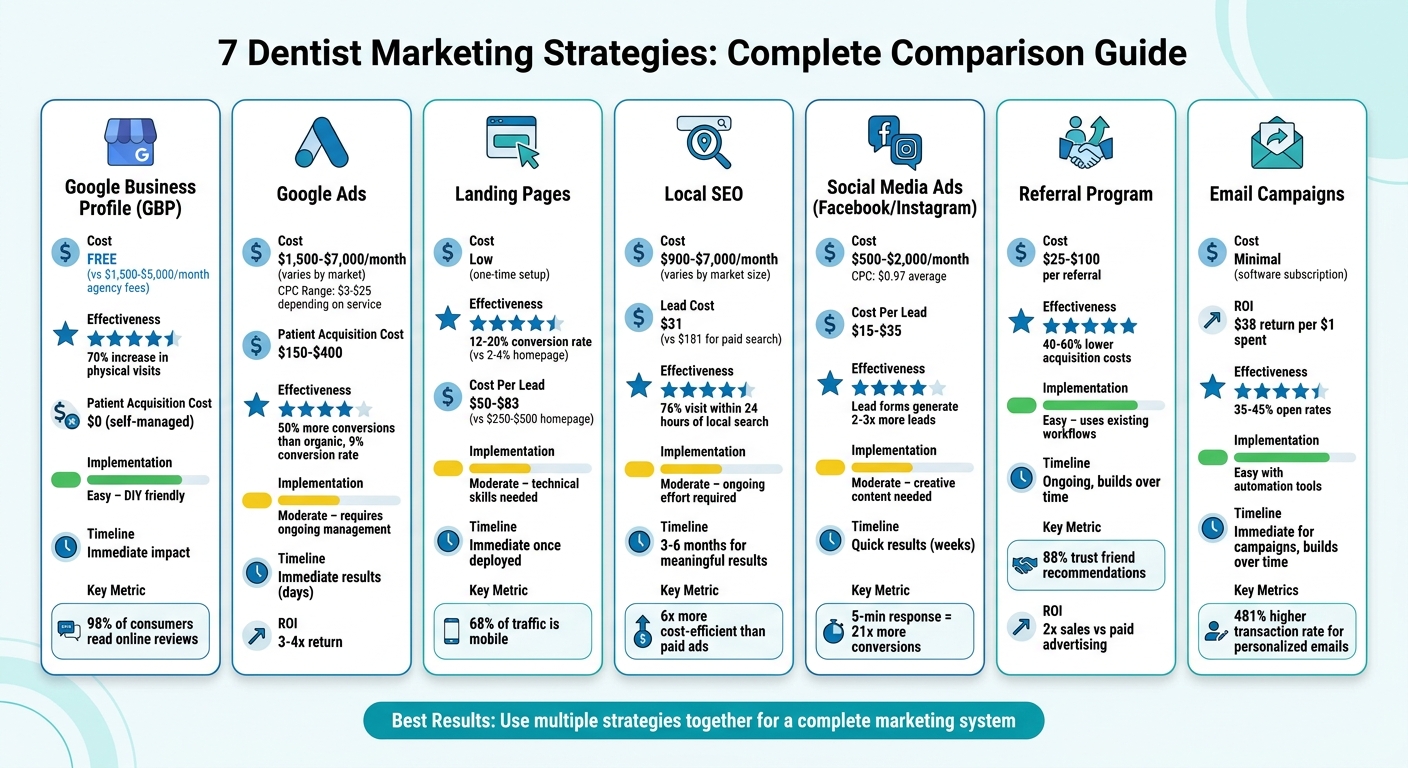
7 Dentist Marketing Strategies Comparison: Cost, Effectiveness & Implementation
Step-by-Step Breakdown of Dental Marketing Strategies
sbb-itb-d8a1e45
1. Optimize Your Google Business Profile for Local Maps Search
Your Google Business Profile (GBP) is the most critical digital asset for local patient acquisition. When a user searches for "teeth whitening in [your city]", your GBP is the first piece of information they see. Nearly 50% of all Google searches have local intent, meaning a fully filled-out profile dictates whether a patient calls your office or your competitor's.
"Your Google Business Profile (GBP) is your most valuable digital asset. It's the first impression for the vast majority of potential patients." - Safa Tash
Driving New Patient Foot Traffic with GBP
Optimizing your GBP directly improves your ranking in the Google Local Pack, which can increase physical visits to your office by up to 70%. You must select "Dentist" as your primary category, then add secondary categories like "Pediatric Dentist" or "Emergency Dental Service". Populate the "Services" section with your specific, high-value treatments—like Invisalign or root canals—so Google actively matches your profile to those exact user searches.
Uploading over 100 high-quality photos of your office interior, exterior, and staff significantly boosts user engagement. You should also utilize weekly Google Posts to promote time-sensitive offers, such as a "$99 New Patient Cleaning Special," forcing immediate action right from the search results.
Managing Your GBP to Lower Acquisition Costs
Creating and managing a Google Business Profile is completely free. By taking the time to update this yourself or having an in-house team member do it, you bypass the $1,500 to $5,000 monthly retainers charged by local SEO agencies. The average cost to acquire a new dental patient through paid channels is $150 to $350, making organic GBP optimization one of your highest ROI activities.
Answering common questions in the GBP Q&A section immediately builds trust and reduces administrative phone calls. Pre-emptively answer questions regarding insurance acceptance, like Delta Dental, or financing options like CareCredit, so patients know exactly what to expect before they even click your website.
Implementing Consistent NAP and Review Automation
Consistency across your Name, Address, and Phone number (NAP) across all online directories is a major ranking factor for Google. Enable the native messaging feature inside your GBP dashboard so patients can text you directly from the search engine. Ensure your profile includes an appointment booking link equipped with UTM tracking parameters, so you know exactly how many bookings came organically from Google Maps.
Review management is strictly non-negotiable, as 98% of consumers read online reviews before choosing a healthcare provider. You must set up an automated CRM workflow that texts or emails patients a review link immediately after their appointment. You also need to respond to every single review—positive or negative—in a HIPAA-compliant manner. Thoughtful responses to negative feedback actually boost trust for 78.3% of consumers reading your profile.
"A professional response to criticism can often build more trust than a dozen 5-star reviews." - Safa Tash
Maintaining an Active Profile for Long-Term Authority
An actively updated Google Business Profile signals to Google’s algorithm and your patients that your practice is operational and attentive. Responding to reviews within a 24-to-72-hour window is expected by 70% of consumers. Because 63% of local searches occur on mobile devices, maintaining accurate "click-to-call" numbers and business hours ensures patients can reach you instantly during emergencies.
2. Launch Targeted Google Ads Search Campaigns
Google Ads allows you to bypass the organic SEO waiting game and place your dental practice exactly where high-intent searchers are looking today. If someone types "emergency root canal near me," you want your ad showing up first. I will tell you right now, if you rely solely on organic search, you are missing out on immediate, ready-to-book patient revenue.
"Google Ads for dental practices delivers immediate patient bookings by placing your practice in front of high-intent searchers actively looking for dental services right now." – Ed Stapleton Jr.
Generating Immediate Leads with High-Intent Keywords
Paid search ads generate 50% more conversions than organic results because they capture users at the exact moment of need. The dental industry enjoys an average Google Ads conversion rate of roughly 9%, dwarfing the general healthcare average of 3.36%. For example, Discovery Children's Dentistry in Carlsbad, CA, generated over 1,000 monthly leads by rigorously segmenting their ad groups and utilizing mobile-optimized landing pages.
Targeting exact match and phrase match keywords like "dentist accepting new patients" prevents your budget from bleeding into irrelevant search queries. You must segment your campaigns by service category—General, Emergency, Cosmetic, Implants—so you can aggressively allocate budget toward procedures like dental implants, where a single patient lifetime value ranges from $3,000 to $30,000.
Understanding Dental PPC Costs and Budget Allocation
Cost-per-click (CPC) in the dental sector fluctuates heavily based on the specific service you are bidding on. General dentistry terms like "dental cleaning" usually run $3 to $8 per click, whereas competitive terms like "dental implants near me" can easily cost $15 to $25 per click. Your target Cost Per Acquisition (CPA) for a new patient will generally sit between $150 and $400.
| Service Type | Estimated Cost Per Click (CPC) | Estimated Cost Per New Patient (CPA) |
|---|---|---|
| General Dentistry | $3–$8 | $150–$250 |
| Emergency Care | $8–$15 | $75–$150 |
| Cosmetic/Veneers | $5–$12 | $300+ |
| Dental Implants | $15–$25 | $300+ |
Building a robust negative keyword list is the most important thing you can do to protect your budget. You absolutely must exclude terms like "jobs," "salary," "free," "DIY," and "school" before you launch, or you will waste up to 40% of your spend on people looking for dental assistant jobs. You can also deploy ad scheduling to bid higher during after-hours emergencies or weekends when competitor bids drop.
"The cheapest clicks come during hours most practices ignore... A toothache that was manageable at 2pm becomes unbearable by 8pm." – Chris Kirksey, CEO, Direction.com
Structuring Campaigns and Ad Extensions Properly
A starting monthly budget of $1,500 to $3,000 is necessary for a mid-sized market, while highly competitive metros require $3,000 to $7,000 to see statistical significance. Do not use broad match keywords when starting out; rely strictly on phrase and exact match. Furthermore, you must track every single phone call using software like CallRail or CallTrackingMetrics, integrating that data back into Google Ads as offline conversions.
Ad extensions are mandatory for taking up more digital real estate on the search results page. Utilize call extensions, location extensions, and sitelinks to give users multiple pathways to contact you. Once your account successfully tracks 30 conversions within a 30-day window, you can safely test Google's AI-driven Smart Bidding strategies like Target CPA.
"The practices that win aren't necessarily spending the most: they're spending the smartest." – Dentplicity Team
Calculating ROI and Lifetime Patient Value
A strictly managed Google Ads campaign historically provides a 3x to 4x Return on Ad Spend (ROAS) for dental clinics. The true value lies in patient retention; while it costs $200 to acquire the patient, they will likely generate $700 to $1,500 in year one. If they bring their family, that lifetime value scales past $10,000. Do not pause your campaigns the minute you get busy; continuously optimize your search terms to lower your CPA over time.
3. Build Service-Specific, High-Converting Landing Pages
Sending paid Google Ads traffic to your generic website homepage is the fastest way to waste your marketing budget. Dedicated landing pages strip away all navigation and distractions, forcing the user to focus entirely on the single service they searched for. If someone clicks an ad for "Invisalign," they need to land on a page exclusively about Invisalign with a clear booking form.
"A Google Ads landing page has exactly one job: get this visitor to book an appointment for the specific service they searched for." – BestPPC
Properly built landing pages drastically reduce your Cost Per Lead by converting traffic at much higher rates. Standard homepages convert traffic at roughly 2% to 4%, whereas targeted landing pages routinely convert at 12% to 20%. By boosting your conversion rate, a $250 lead suddenly drops to an $83 lead without changing your Google Ads bids.
Message Match Between Your Ad and Landing Page
Message match dictates that your landing page headline must exactly mirror the text of the ad the user just clicked. If your ad promotes a "Free Invisalign Consultation," your landing page header must say "Claim Your Free Invisalign Consultation." You have about three seconds to assure the visitor they are in the right place before they hit the back button and click a competitor.
Removing Friction from Lead Capture Forms
Your lead capture form must ask only for the absolute minimum information required to book the appointment: Name, Phone Number, and desired Service. You must replace passive submit buttons like "Submit" with high-intent Call-To-Action (CTA) buttons like "Book My Appointment" or "Claim My Special." Every extra field you add to a form decreases your conversion rate.
Optimizing Page Speed and Mobile Experience
Because over 68% of dental searches occur on mobile devices, your landing page architecture must load in under three seconds. Slow pages kill conversions; a one-second delay can drop conversions by 20%. Compress your images using WebP formats, ensure you have a sticky "Tap-to-Call" button anchored to the bottom of the mobile screen, and verify the page structure using Google PageSpeed Insights.
Data privacy is critical in healthcare marketing. Ensure you are using HIPAA-compliant form builders like Jotform Health or Formstack to capture patient data securely.
Tailoring Trust Elements to Specific Procedures
Trust elements must be customized to the exact procedure outlined on the landing page. A Dental Implants page must feature financing options, clear timeline expectations, and high-quality before-and-after photos. An Emergency Dentistry page needs a massive phone number, a "Call Now" CTA, and clear messaging regarding same-day availability. Never use stock photos; always use authentic images of your actual staff and office.
Enabling After-Hours Online Scheduling
Roughly 40% of dental appointments are booked outside of standard business hours. Embedding a direct online scheduling widget onto your landing page ensures you capture leads at 11 PM when your front desk is closed. You must constantly run A/B tests on your landing page headlines, button colors, and form placement to continuously squeeze a higher conversion rate out of your paid traffic.
4. Implement Local SEO for Organic Ranking
Local Search Engine Optimization (SEO) ensures your website ranks organically beneath the paid ads and within the Google Maps section for terms like "dentist near me." While Google Ads yields immediate results, Local SEO builds sustainable, long-term traffic equity for your specific geographic location.
The High ROI of Organic Search Traffic
Organic SEO generates the lowest cost-per-lead over a long-term horizon, averaging roughly $31 per lead compared to paid search at $181. Once your pages rank on the first page of Google, you do not pay per click for the traffic generated. Independent practices rely on Local SEO to compete effectively against corporate dental groups.
"Local SEO is where independent practices compete on a level playing field".
Dominating the Local Search Pack
Securing a position within the Google Local Pack (the top three map results) drives an immense volume of localized phone calls. Data shows that 76% of users who execute a local mobile search visit a business within 24 hours. Because online reviews account for roughly 24% of the local ranking algorithm, acquiring 3 to 5 authentic patient reviews per week is mandatory for SEO dominance.
Structuring On-Page SEO for Dental Services
Executing on-page SEO requires building out separate, keyword-optimized pages for every single service you offer. You cannot rely on one generic "Services" page; you need a `/dental-implants`, a `/teeth-whitening`, and a `/root-canals` page. Ensure your Name, Address, and Phone number (NAP) are hard-coded into the footer of your website and perfectly match your Google Business Profile data.
If you hire an agency, expect to pay between $900 and $2,500 per month for standard Local SEO in smaller markets, scaling up to $4,000+ in highly competitive metros. They will focus on building local backlinks, optimizing your site speed, and writing geo-targeted content.
Building a Long-Term Content Moat
SEO is a compounding investment that typically requires 3 to 6 months to show significant momentum. Regularly publishing hyper-local content and updating your Google Business Profile directly influences your click-to-call metrics. Automating review requests via your practice management software ensures your practice continuously generates the fresh user-generated content that Google's algorithm favors.
5. Run Geo-Targeted Meta (Facebook & Instagram) Ads
Meta Ads (Facebook and Instagram) operate as a demand-generation channel, interrupting users who were not actively searching for a dentist but are susceptible to a compelling offer. While Google Ads captures existing intent, social media ads create new intent by showcasing visual transformations and introductory specials directly in the user's feed.
"Facebook Ads creates patients who weren't thinking about the dentist at all - until your ad interrupted their scroll with an offer they couldn't ignore."
Budgeting for Low-Cost Social Media Leads
Advertising on Meta yields significantly cheaper clicks than Google Search, often averaging around $0.97 per click with lead costs ranging from $15 to $35. A standard monthly budget of $500 to $1,000 is sufficient for a solo practitioner to test the platform. To keep your ad spend efficient, you must restrict your geographic targeting to a strict 5 to 15-mile radius around your physical office.
Uploading a CSV file of your current patient database into Meta Ads Manager allows the algorithm to generate a "1% Lookalike Audience." This tells Facebook to find local users whose data profiles match your best existing patients, drastically improving your lead quality.
Lead Forms vs. Custom Landing Pages
The speed at which your front desk contacts a social media lead dictates your conversion rate. Calling a lead within 5 minutes of form submission increases your chance of booking the appointment by 21 times. You must decide between using Meta's native Lead Forms or directing traffic to your own landing pages.
Native Lead Forms keep the user inside Facebook, generating a higher volume of leads at a cheaper cost ($15–$25), but they often result in lower intent and higher no-show rates. Sending users to a dedicated external landing page costs more per lead ($25–$45) but significantly improves the actual appointment show rate.
| Metric | Meta Native Lead Form Ads | External Landing Page Ads |
|---|---|---|
| Cost Per Lead | $15–$25 | $25–$45 |
| Lead-to-Appointment Rate | 40–60% | 55–70% |
| Appointment Show Rate | 60–70% | 75–85% |
| Cost Per Booked Patient | $35–$70 | $45–$80 |
Deploying Video Creatives and Retargeting Pixels
You must install the Meta Pixel on your website before launching any campaigns. The Pixel tracks users who visited your website organically or through Google Ads, allowing you to run cheap "retargeting" campaigns to users who bounced without booking. Warm retargeting audiences are 3 to 5 times more likely to convert than cold audiences.
Avoid highly produced, stock-video commercials. Authentic, 15-to-30-second selfie-style videos shot on an iPhone by the dentist perform significantly better on social platforms, often boosting conversions by 86%. You need to refresh your ad creatives every two to three weeks to combat ad fatigue.
Staying Top-of-Mind in the Local Community
Running consistent social media ads ensures your brand remains visible to the local community year-round. Because over 70% of adults use social media to validate local businesses, consistent organic posting paired with paid retargeting builds a layer of trust that makes your practice the default choice when a dental need eventually arises.
6. Build an Incentivized Patient Referral Program
A formalized patient referral program systematically leverages word-of-mouth marketing, generating high-trust leads that close at a much higher rate than cold paid traffic. Consumers trust personal recommendations more than any advertisement, making referrals the highest quality patient you can acquire.
"Referrals are the lowest-cost, highest-quality source of new patients. Yet most practices leave referrals to chance."
Lowering Patient Acquisition Costs (PAC)
Referral programs drastically lower your overall Cost Per Acquisition because you only pay the incentive after the new patient actually books and completes an appointment. The effective cost of a referral usually runs between $25 and $100, which is a fraction of standard Google Ads PAC.
You must review your specific state dental board regulations regarding referral incentives before launching. Some states strictly cap incentives or ban direct cash payouts. Offering account credits for future cosmetic services, electric toothbrushes, or local restaurant gift cards are highly effective, compliant alternatives.
Systematizing the Ask at the Front Desk
You cannot rely on patients to organically remember to refer you. You must train your front desk staff to physically hand out referral cards or point to a QR code at the exact moment of patient checkout when satisfaction is highest. Integrate the referral messaging into your automated post-appointment text messages and monthly email newsletters.
Your practice management software should be configured to track the exact source of every referred patient, allowing you to properly credit the referrer and measure the program's overall financial impact.
Fostering Community Loyalty
Patients acquired through personal referrals have higher treatment plan acceptance rates and demonstrate significantly higher long-term retention. Acknowledging a referral with a handwritten thank-you note cements the relationship with the referring patient, practically guaranteeing their continued loyalty.
7. Execute Targeted Email Marketing Campaigns
Email marketing monetizes your existing patient database by driving repeat bookings, reactivating lost patients, and pushing high-margin elective services. With an average return of $38 for every $1 spent, email remains the most scalable and cost-effective retention channel available.
Deploying Seasonal and Segmented Offers
Email campaigns generate massive revenue spikes when tied to seasonal events or insurance deadlines. Sending "Use It or Lose It" email blasts in October and November forces patients to book appointments before their annual dental benefits expire. Promoting a "Spring Wedding Teeth Whitening Package" converts subscribers into buyers of high-margin cosmetic services.
Segmentation is key. Sending a personalized "Happy Birthday" email with a small discount code increases transaction rates by nearly 500%. Do not blast the exact same email to your entire list; segment your list into active patients, inactive patients, and leads who never booked.
Automating Patient Communication Workflows
Modern CRM platforms allow you to completely automate these email sequences. You must set up an automated "Welcome Series" for every new patient that explains office policies, introduces the doctor, and sets expectations.
Because the vast majority of emails are opened on mobile devices, your email design must use a single-column layout with massive, highly visible "Book Appointment" buttons. Link these buttons directly to your online scheduling widget to remove all friction from the booking process.
Reactivating Lapsed Patients
The average dental practice faces a 17% annual patient attrition rate. You must run automated "Reactivation Campaigns" targeting patients who have not been in the office for 9 to 12 months. An automated email stating "It's been a while" paired with an easy booking link is the cheapest way to plug the holes in your patient bucket.
Summary
Scaling a dental practice requires stacking these marketing channels so they feed into one another. You cannot rely on just one tactic if you want consistent, predictable growth.
"Real growth comes from running every channel that drives new patients at the same time, so a patient researching a dentist finds you in the Maps pack, sees your name on Google search results, recognizes your practice from Facebook or Instagram, and lands on a website that makes booking an appointment easy".
You must start with the foundation: a conversion-optimized website and a flawless Google Business Profile. Once that infrastructure is built, allocate your budget toward high-intent Google Ads search campaigns mapped to dedicated landing pages. Finally, deploy Meta Ads, referral programs, and automated email sequences to generate demand and maximize the lifetime value of every patient who walks through your door. Track every call, measure your Cost Per Acquisition, and aggressively scale the campaigns that actually put patients in the chair.
Frequently Asked Questions
Which marketing strategy should a dental practice start with first?
You must establish a strong foundational online presence before spending money on ads. Start by fully optimizing your Google Business Profile and ensuring your website is fast, mobile-friendly, and built for conversions. Once your organic foundation is capturing local search traffic, deploy targeted Google Ads to aggressively acquire high-value patients.
How do I accurately track where my new patient phone calls are coming from?
Implementing dynamic call tracking software is the only way to accurately attribute phone calls to specific marketing campaigns. Call tracking assigns unique phone numbers to your Google Ads, your website, and your social media profiles, allowing you to see exactly which keyword or ad resulted in a booked appointment and protecting your marketing budget.
How long does Local SEO take to generate new dental patients?
Local SEO generally requires 3 to 6 months of consistent optimization to yield a noticeable increase in patient volume. You must actively generate weekly Google reviews, fix technical website errors, and publish geo-targeted service pages to prove your authority to Google's ranking algorithm over time.
0 comments