

Running ads without checking what your competitors are doing? That’s like playing a game without knowing the rules. Competitor ad analysis tools help you see what’s working for others so you can improve your campaigns. From spotting keywords to analyzing landing pages, these tools save you time and money by showing you proven strategies.
Here’s a quick look at five tools that can help:
- Semrush: Tracks keywords, ad copy, and landing pages with detailed insights. Plans start at $139.95/month.
- SpyFu: Offers 19 years of data on competitor ads, keywords, and budgets. Plans start at $39/month.
- iSpionage: (Now part of TapClicks) Previously tracked PPC keywords and landing pages. Pricing began at $59/month.
- Ahrefs: Known for SEO, but also useful for paid keyword and ad analysis. Pricing starts at $99/month.
- Surfside PPC: Focuses on training and consulting for ad analysis. Services start at $500/month.
Each tool has unique strengths, from budget-friendly options to advanced features for agencies. Below, we break down their features, pricing, and best use cases to help you decide.
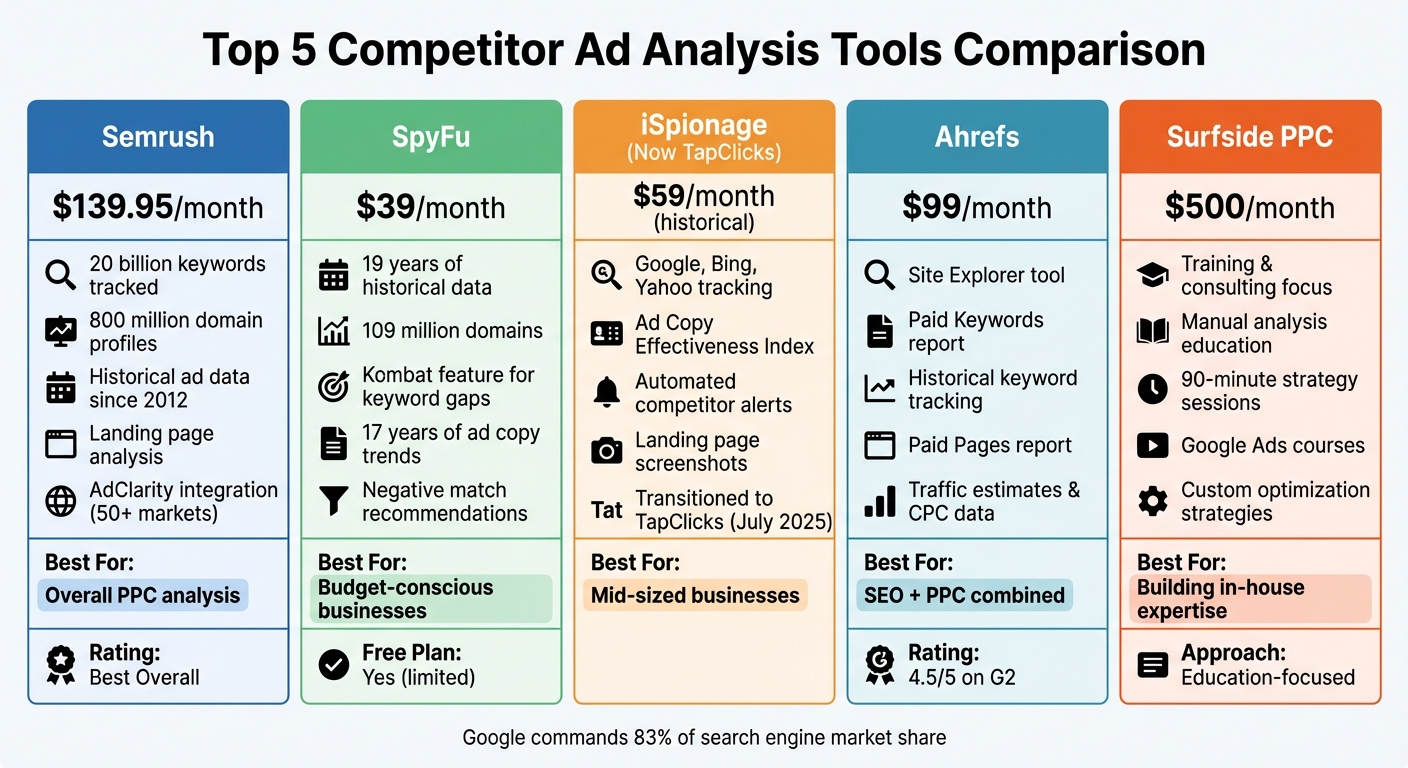
Competitor Ad Analysis Tools Comparison: Features and Pricing
These 9 TOOLS Will Help You SPY On Your Competitors
sbb-itb-d8a1e45
1. Semrush

Semrush is a go-to platform for uncovering what your competitors are doing with their Google Ads campaigns. With a database that tracks over 20 billion keywords and 800 million domain profiles, it’s a treasure trove of insights for marketers.
Competitor Keyword Analysis
The Advertising Research tool lets you dive into your competitor's domain to see the keywords they’re bidding on. It also provides estimates of their monthly PPC budget and spending on specific terms. Using the Keyword Gap feature, you can identify lucrative keywords that your competitors rank for but you’re currently missing out on. To make things easier, Semrush assigns each keyword a Keyword Difficulty (KD) score (ranging from 0–100%), which helps you assess how tough it might be to outrank competitors.
Ad Copy Insights
Semrush doesn’t just stop at keywords - it also provides access to historical ad data dating back to 2012. This means you can see the exact headlines and descriptions your competitors have tested over the years. With the AdClarity integration, you can track display, video, and social ad campaigns across 50+ markets. Plus, the PLA Research tool focuses on Google Shopping campaigns, showcasing the products and keywords driving the best results.
Landing Page Analysis
Want to know where your competitors are sending their paid traffic? Semrush pinpoints the exact landing pages they use, giving you a glimpse into their conversion funnels. You can even benchmark your site against up to five competitors at once to compare organic traffic, paid traffic, and backlink profiles. Aaron Harrison, a Performance Marketing Expert, sums it up perfectly:
"Semrush allows you to look behind the curtain at what your competition is doing with their Google Ads strategy. It's like being in the front row of the Google Ads showdown, and you do not want to miss out on any second of the game."
All these tools are seamlessly integrated into Semrush’s subscription plans.
Pricing Plans
Semrush offers three main pricing tiers: Pro at $139.95/month, Guru at $249.95/month, and Business at $499.95/month. For those focused specifically on advertising, the Advertising Toolkit comes in two options: the Base plan at $99/month (covering search ads only) and the Pro plan at $220/month, which includes insights into display, video, and social ads through AdClarity. While it’s rated as the "Best Overall" tool for PPC competitor analysis, keep in mind it might take some time to fully master.
2. SpyFu
SpyFu taps into 19 years of data from 109 million domains to help you uncover winning ad strategies and refine your PPC campaigns.
Competitor Keyword Analysis
SpyFu's Kombat feature lets you compare competitors to find core keywords you're missing. Their Google Ads Advisor digs into competitor bidding histories to suggest the most profitable keywords for your niche. Meanwhile, the Negative Match Recommendations tool identifies costly broad-match keywords that competitors have tested and dropped, helping you steer clear of wasting money on terms that don’t convert. As Bradley Roberts, Vice President of Client Strategy, notes:
"I have compared their data with my own clients' data and it is really close and more than directional."
These tools provide a solid foundation for fine-tuning your ad performance.
Ad Copy Insights
SpyFu tracks 17 years of competitor ad copy trends, spotlighting "already-tested" ads that consistently perform well. You can even click on an ad to see where that same copy is used across different keywords, revealing patterns in their messaging strategy. Sidra Condron from SpyFu explains:
"Sites won't let weak ad copy run too long. They tweak and test it as they get closer to their conversion goals."
This insight into ad copy evolution can guide your own messaging strategies.
Landing Page Analysis
SpyFu also provides snapshots of competitors' landing pages, offering a glimpse into their conversion funnels and layout strategies.
Pricing Plans
SpyFu's Free for Life plan allows unlimited searches but limits results to 10 per search. The Basic Plan, priced at $39/month, includes unlimited search results and tracks up to 5,000 keyword rankings weekly. For deeper analysis, the Professional Plan is available at $78/month, increasing weekly tracked keyword rankings to 15,000 and offering custom branded reports. All plans include a 30-day money-back guarantee.
3. iSpionage
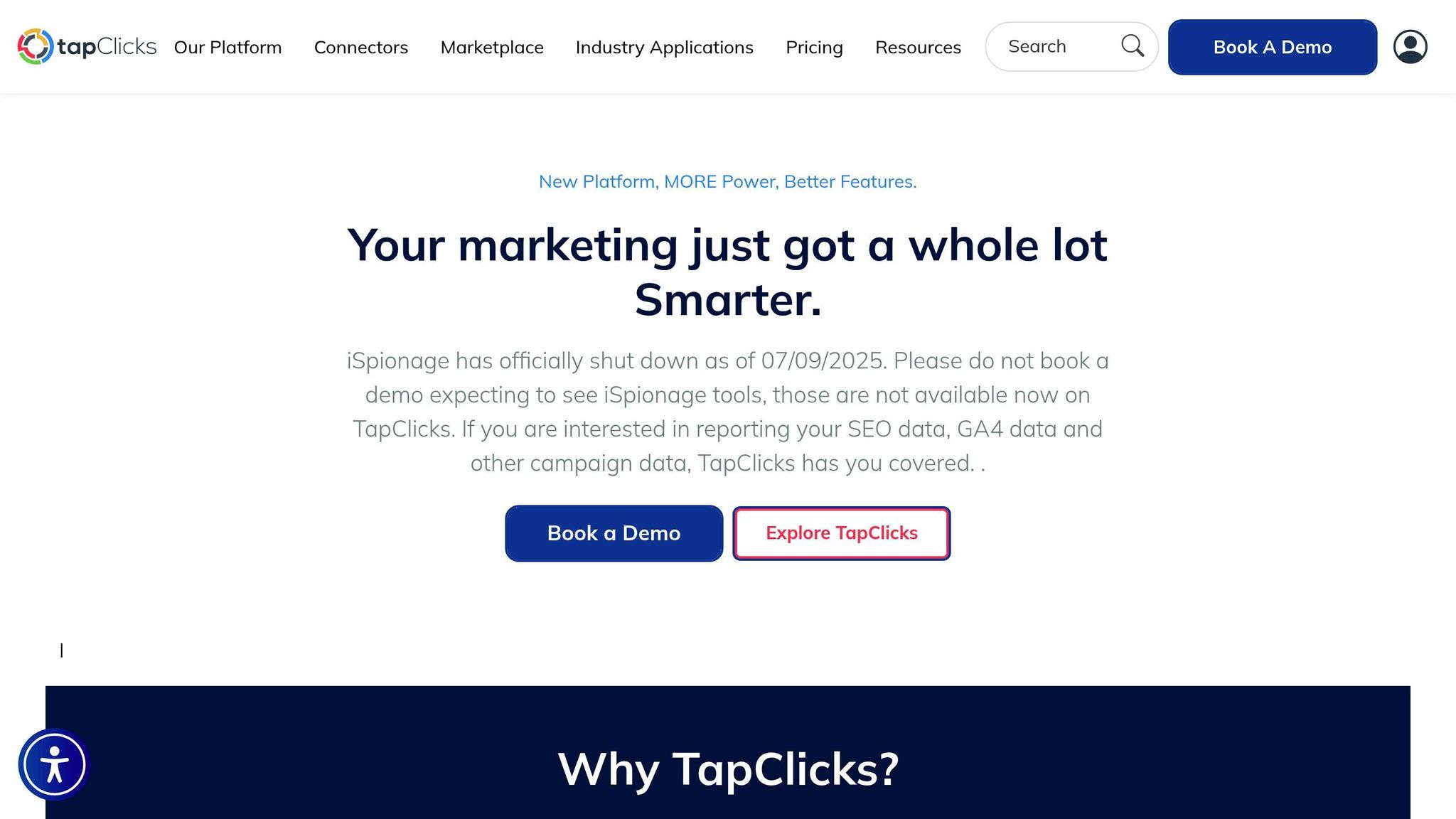
Important Note: iSpionage officially ceased its standalone services on July 9, 2025, transitioning its features and data reporting to the TapClicks platform. While now a part of TapClicks, iSpionage's historical capabilities still serve as a benchmark for competitor analysis tools available today.
Competitor Keyword Analysis
iSpionage monitored PPC keywords across Google, Bing, and Yahoo. It provided detailed performance metrics such as average ad position, estimated monthly ad spend, and monthly clicks for competitor campaigns. One particularly useful feature was its automated alerts, which notified users of new competitor bids.
Ad Copy Insights
Beyond keyword tracking, iSpionage offered tools to refine ad messaging for better conversion rates. It included a visual timeline of competitor ads and an "Ad Copy Effectiveness Index" to highlight the most successful campaigns. Marketers could dive into individual ads and their performance metrics, making it easier to benchmark and adjust their own strategies. By identifying ads with the longest run times, users could pinpoint messaging that consistently delivered strong results for competitors.
Landing Page Analysis
iSpionage also provided visual insights into competitor landing pages, offering screenshots that revealed how conversion funnels were designed. It highlighted the most effective landing pages for each competitor, showcasing elements like call-to-action placement and overall design. This allowed advertisers to reverse-engineer successful strategies without relying on guesswork.
Pricing Plans
iSpionage had a free plan with basic features, while its premium plans started at $59 per month. For those looking for similar functionalities, TapClicks now offers these capabilities.
4. Ahrefs
Ahrefs, widely recognized for its SEO capabilities, also proves to be a powerful tool for analyzing competitor paid search strategies. Its Site Explorer tool goes beyond Google Keyword Planner, offering a detailed look at competitor bidding strategies. You can uncover keywords they're targeting, along with metrics like CPC, search volume, and estimated traffic.
Competitor Keyword Analysis
The Paid Keywords report provides a wealth of data, including ad positions, traffic estimates, and landing page URLs. With the Keyword Gap feature, you can spot profitable keywords that your competitors are leveraging but you may have overlooked. Plus, Ahrefs tracks historical keyword data, helping you understand how your competitors' strategies evolve over time.
"With Ahrefs, you'll see exactly which keywords your competitors are bidding on, the countries they're targeting, and what ads and landing pages they use - something you can't do with Google Keyword Planner."
– Mateusz Makosiewicz, Marketing Researcher, Ahrefs
The platform also includes a Paid Ads report, which dives deeper into competitor ad strategies and creative approaches.
Ad Copy Insights
The Paid Ads report showcases active Google ads from your competitors. It provides insights into creative elements and historical ad data, helping you refine your own messaging strategies. By analyzing this data, you can gain a clearer picture of what resonates with your audience.
Landing Page Analysis
Ahrefs' Paid Pages report identifies which landing pages are driving the most paid traffic and ad spend. It offers details like traffic estimates, the number of keywords each page ranks for in paid search, and the estimated cost of that traffic. You can filter for PPC-specific URLs using terms like "lp", "landing", or UTM tags. This feature highlights where competitors are focusing their ad budgets and which products or services are getting the most attention.
Pricing Plans
Ahrefs offers four main pricing tiers: Lite for $99/month, Standard for $199/month, Advanced for $399/month, and Enterprise for $999/month. Some reports also mention a Starter plan at $29/month for basic tracking. On G2, Ahrefs holds a strong 4.5/5 rating based on over 500 reviews. However, some PPC specialists note that its paid ads data might not be as detailed as what dedicated SEM tools provide.
5. Surfside PPC
Surfside PPC focuses on education and personalized consulting to help marketers master competitor ad analysis through third-party tools. Instead of offering a standalone platform, Surfside PPC provides training and consulting services designed to teach you how to analyze competitor strategies effectively. This hands-on approach helps marketers gain actionable insights into ad copy and landing page performance.
Ad Copy Insights
Surfside PPC takes a unique approach by teaching you how to analyze competitor strategies manually, rather than relying on automated tools. You'll learn to evaluate historical data, uncover changes in competitor messaging, and identify the ad copy and headlines used by rivals on platforms like Google Ads and Meta. By combining data from various analysis tools, this training provides a well-rounded view of your competitors' creative tactics.
Landing Page Analysis
When it comes to landing pages, Surfside PPC emphasizes visual evaluation as a key method. You'll be trained to assess competitor pages by reviewing their layout, call-to-action placement, and messaging to determine what drives conversions. This process involves leveraging both free and premium third-party tools to dissect competitor funnels, offering a clear understanding of the customer journey from the initial ad click to the final conversion.
Pricing Plans
Surfside PPC offers several options tailored to different needs. Their Google Ads Management service costs $500 per month and includes dedicated specialist support, a custom strategy, and ongoing optimization. For those who prefer a more hands-on role, Google Ads Consulting sessions provide 90 minutes of strategy advice, including account audits, optimization tips, and guidance on implementation. Additionally, Surfside PPC offers a Google Ads Course and an Inbound Marketing Course for self-paced learning. These courses cover everything from campaign setup to advanced conversion tracking techniques, making them ideal for marketers looking to enhance their skills.
Conclusion
Choosing the right tool for competitor analysis comes down to your budget, platform focus, and the depth of insights you need. For small businesses, SpyFu stands out as an affordable option, offering detailed historical data on Google Ads campaigns. If you're hesitant to commit to a paid tool right away, start by exploring the free Auction Insights feature in Google Ads, which provides valuable platform-specific data.
Mid-sized businesses looking for features like real-time alerts and landing page tracking might find iSpionage particularly helpful, thanks to its historical benchmarks. On the other hand, larger agencies managing multiple clients may find the investment in Semrush worthwhile. Its all-in-one marketing suite is robust, though it does require some extra time to learn. Ahrefs also delivers excellent data accuracy and a user-friendly interface, but its PPC features are less comprehensive compared to tools specifically designed for ad spying.
For those who prefer to develop in-house expertise rather than relying solely on automation, Surfside PPC offers consulting sessions and courses to help you master competitor analysis. At $500 per month for full Google Ads management - or through flexible consulting options - you can learn how to integrate insights from multiple platforms and gain a deeper understanding of what drives your competitors' success. This approach is ideal if you're looking to build internal knowledge alongside using software tools.
Businesses that leverage competitor analysis tools consistently report higher returns on their ad spend. With Google commanding over 83% of the search engine market, understanding your competition has never been more important. Whether you choose SpyFu, Semrush, or Surfside PPC, the key is to start analyzing your competitors today and stop guessing about what works in your market. The sooner you dive in, the sooner you can refine your strategy and maximize your ROI.
FAQs
What should I look for in a tool to analyze competitor ads?
Choosing the right tool for competitor ad analysis can make a big difference in refining your paid media strategy. The ideal platform should offer reliable, up-to-date insights and integrate smoothly into your existing processes - all while staying within your budget.
Here are some key features to prioritize:
- Ad Coverage: Make sure the tool examines all major ad formats, including search, display, video, and social media. It should also provide detailed information on creative assets and ad placements.
- Insight Depth: Look for advanced metrics like keyword-level data, estimated ad spend, and bidding strategies. These details can help you benchmark performance and uncover new opportunities.
- Ease of Use: A straightforward interface, customizable dashboards, and the ability to export reports are essential for turning raw data into actionable strategies.
- Scalability and Cost: Opt for a platform with a pricing model that aligns with your current budget but can also adapt as your ad spend grows.
By zeroing in on these features, you can find a tool that provides the insights you need to stay competitive in the U.S. market.
How can competitor ad analysis tools enhance my advertising strategy?
Competitor ad analysis tools are game-changers for building better ad campaigns. They give you a behind-the-scenes look at your competitors' strategies, including live ad creatives, keywords, estimated budgets, and placement data. This not only saves you time but also takes the guesswork out of planning. By seeing what’s working for others, you can spot trends, fill market gaps, and come up with fresh ideas to make your ads stand out.
The data you gather can be put to work in several ways. For instance, keyword and bid intelligence helps fine-tune your targeting and make smarter budget decisions. Creative benchmarking highlights which headlines, visuals, and calls-to-action are grabbing attention, so you can test and refine your ads more effectively. Plus, knowing which platforms - like Google, Meta, or TikTok - your competitors are prioritizing can help you decide where to focus your energy.
Agencies like Surfside PPC find these tools essential for campaign optimization. By diving into competitor data, they’re able to sharpen keyword strategies, write more effective ad copy, and allocate budgets in ways that drive better ROI.
Are there any free tools for analyzing competitor ads?
Yes, you can find free tools to analyze competitor ads. For instance, Google’s Auction Insights and Ads Grader offer helpful data at no charge. Plus, some third-party platforms provide free versions or limited features that allow you to assess competitor strategies. While these tools might lack the depth of paid options, they’re an excellent way to begin your analysis.