

Need more DUI clients? Here's the key: be visible when it matters most - right after an arrest. Over 76% of people search for legal help on their smartphones within hours of a DUI arrest, often between 12 AM and 3 AM, when most law firms are closed. If your firm isn't showing up at the top of search results, you're losing potential clients to competitors.
Key Takeaways:
- Google Ads (PPC) works fast: Get your firm in front of urgent searches like "DUI lawyer near me" or "arrested for DUI help."
- Focus on high-intent keywords: Phrases like "24/7 DUI lawyer" or "emergency DUI attorney" convert better.
- Target late-night searches: DUI-related searches peak at night; use call-only ads for immediate leads.
- Build mobile-friendly landing pages: Fast-loading pages with clear CTAs (e.g., "Call Now") can boost conversions from 2–4% to 8–15%.
- Track performance: Monitor metrics like Cost-per-Lead (CPL), Conversion Rate, and Return on Ad Spend (ROAS) to optimize your campaigns.
Quick Tip:
Use negative keywords (e.g., "free legal advice", "public defender") to avoid wasting ad spend on non-converting traffic.
With the right strategy, you can dominate search results, connect with urgent clients, and maximize your ROI. Keep reading for actionable steps to build a winning PPC campaign for your DUI practice.
DUI / DWI Lawyer Google Ads PPC Case Study
sbb-itb-d8a1e45
Keyword Research and Optimization for DUI Campaigns
Mastering keyword research is a cornerstone of any successful PPC campaign, especially when targeting DUI clients who often need urgent assistance.
Finding High-Intent DUI Keywords
Understanding the difference between transactional and informational keywords is key. For instance, a search like "DUI penalties in California" suggests someone seeking general information, while "DUI lawyer near me right now" at 2 AM indicates an urgent need for legal help.
Transactional keywords are gold for conversions because they show intent to hire. Phrases like "best DUI attorney", "emergency DUI lawyer", or "DUI lawyer free consultation" are common during crisis moments. These searches often spike late at night on weekends - right when DUI arrests are most frequent.
To capture these high-intent clients, allocate your budget to emergency-focused keywords such as "24 hour DUI lawyer", "how to avoid jail tonight", or "DUI lawyer open now." These terms attract people ready to act immediately. With over 27,100 searches for "DUI Lawyers" each month in the U.S., and 76% of these searches happening on mobile devices, staying visible during these critical moments can make all the difference.
On the flip side, avoid wasting your ad spend on purely informational searches. Use negative keywords like "public defender", "free legal advice", "DUI laws", "DUI prevention", and "DUI statistics" to filter out users who aren't ready to hire.
Using Long-Tail Keywords for Specific Cases
Long-tail keywords often convert better - 2.5× higher, to be exact - because they address highly specific needs. Instead of competing for costly, generic terms like "DUI lawyer" (which averages $64.02 per click), focus on phrases like "first offense DUI lawyer", "2nd DUI lawyer", or "out-of-state DUI charges".
These targeted keywords not only face less competition but also attract clients further along in their decision-making process. For example, someone searching "attorney for second DUI offense" is likely ready to hire, compared to someone casually searching "DUI attorney." Similarly, terms like "DUI lawyer payment plan" or "affordable DUI attorney near me" (which average $35.57 per click) appeal to budget-conscious clients who are ready to take action.
Hyper-local targeting can amplify the impact of long-tail keywords. Pair DUI-related terms with specific locations, such as "Mesa DUI lawyer" or "Chandler DUI lawyer", to connect with mobile users seeking help in their immediate area.
A great example of this strategy in action comes from Constellation Marketing, which revamped Philip Kim Law's digital approach in Georgia. By focusing on high-intent DUI keywords and optimizing for mobile, the firm saw a 435% revenue increase and averaged 14 new signed clients per month.
Keyword Match Types and Campaign Structure
Google Ads offers three keyword match types, each serving a distinct purpose:
- Exact Match: This provides the most control, showing your ad only for the specific term you target, such as "best DUI lawyer in Phoenix." It minimizes wasted spend and delivers high-quality leads, making it ideal for your most valuable keywords.
- Phrase Match: A middle ground between reach and relevance, this match type triggers ads for searches that include your keyword phrase in the same order, with some flexibility for added words. For example, targeting "DUI lawyer" in phrase match might also show ads for "affordable DUI lawyer near me" or "experienced DUI lawyer consultation", capturing variations while maintaining intent.
- Broad Match: While broad match offers maximum reach, it can be risky due to high costs - clicks can range from $50 to $150. To use it effectively, pair it with a robust negative keyword list to avoid irrelevant traffic.
To make the most of your keywords, structure your campaigns into tightly focused ad groups. For example, create separate groups for themes like "First Offense DUI", "License Suspension", "DUI Court Representation", and "Cost/Fees." This not only improves your Quality Score but also ensures your ads are highly relevant to the searcher's intent. For instance, someone searching "how to get license back after DUI" should see an ad specifically about license reinstatement, not a generic services page. Well-structured campaigns also set the stage for crafting compelling ad copy and landing pages that convert.
Creating Effective Ad Copy and Landing Pages
With DUI-related clicks costing anywhere from $50 to $150, every click counts. This makes it crucial to create ads and landing pages that convert immediately.
Writing Ad Copy for DUI Attorneys
Most DUI-related searches happen between midnight and 3 AM. This means your ad copy needs to address urgency and build trust instantly. Avoid generic phrases like "experienced attorney" and focus on specific results. As Patrick Carver, CEO & Founder of Constellation Marketing, puts it:
"Generic success claims don't convert as well as actual results like 'Case dismissed – Blood alcohol level 0.12'".
Your headlines should combine local relevance with urgency. For example, instead of "DUI Lawyer", try "Phoenix DUI Lawyer – Free Consultation 24/7" or "Arrested in Mesa? Call Now." Adding your city or county grabs attention from local searchers and improves click-through rates. Since 76% of DUI searches occur on mobile devices, include call assets for one-tap dialing.
Trust is just as important as urgency. Highlight your experience, state bar number, or awards directly in your ad. Phrases like "500+ Cases Won" or "Former Prosecutor" help build credibility quickly. Keep your call-to-action direct and actionable with phrases like "Call Now for a Free Consultation", "Get Help Tonight", or "Talk to a DUI Lawyer Now".
During peak hours - midnight to 3 AM - use call-only ads. These skip the landing page entirely, connecting potential clients straight to your phone line.
Once you've captured attention with compelling ad copy, your landing pages need to carry that momentum to convert high-intent visitors.
Building Landing Pages That Generate Leads
Dedicated landing pages typically convert 8–15% of visitors, compared to just 2–4% for homepages. The key difference? Focus.
"A landing page has one purpose: convert this specific visitor into a lead, right now." - BestPPCFirm
Your landing page should build on the keywords and messaging from your ads. The above-the-fold section - what visitors see before scrolling - is critical. You’ve got about 5 seconds to make an impression. This section should include:
- A headline matching the visitor’s search intent.
- A concise value proposition (e.g., "Former Prosecutor with 500+ DUI Cases Won").
- A visible contact method, like a phone number and a short form.
Since DUI arrests can happen at any time, your landing page must be designed for emergencies. Use a sticky "Call Now" button that stays visible as users scroll, emphasize your 24/7 availability, and consider adding live chat for after-hours inquiries.
Keep your contact forms simple - 3 to 5 fields max. Ask for essentials like Name, Phone Number, and Case Description. Each extra field reduces conversion rates by 5–10%. Remember, these users are often stressed and looking for quick help, not lengthy forms.
Trust signals play a huge role in converting visitors. Use specific outcomes like "Over 500 DUI Cases Won" rather than vague claims. Display your bar number, years of experience, and client testimonials. Video testimonials, in particular, can convert 2–3 times better than text-based ones. Include badges from Avvo, Super Lawyers, or your state bar association to further build credibility.
Page speed is another critical factor. If your landing page takes more than 3 seconds to load, you could lose up to 40% of visitors. Use tools like Google Lighthouse to ensure your mobile performance score stays above 80. With clicks costing $50–$150, a slow page is an expensive mistake.
Finally, eliminate navigation menus from your landing pages. These menus give visitors too many opportunities to leave. Keep them focused on one action: contacting your firm.
Matching Ad Copy with Landing Page Content
Consistency between your ad copy and landing page content is crucial for trust and conversions. Message match - ensuring your ad and landing page deliver the same promise - can boost conversion rates by 30–50%. For example, if your ad offers a "Free Consultation", your landing page headline should prominently feature that exact phrase. This not only builds trust but also improves your Google Quality Score, which can lower your cost-per-click.
"A landing page that converts at 8% instead of 4% doesn't just double your leads - it halves your cost per case." - BestPPC
Direct PPC traffic to dedicated landing pages. If someone clicks an ad for "First Offense DUI Lawyer in Chandler", they should land on a page specifically about first-offense DUI defense in Chandler - not a generic practice areas page.
Experiment with A/B testing to refine your headlines and calls-to-action (CTAs). Small tweaks, like testing "Get Help Now" versus "Free Case Evaluation", can improve conversion rates by 10–20%. Use tools like CallRail to track which ad copy and keywords drive the best phone leads.
A great example comes from the Law Office of Valery Nechay in San Francisco. By implementing a content SEO and landing page strategy, they boosted their authority with educational pages and optimized for high-intent keywords. The result? A 3x revenue increase and first-page rankings for over 283 competitive keywords.
Your landing page tone and language should mirror your ads. If your ad emphasizes authority and urgency, your landing page must do the same. If your ad highlights 24/7 availability, that message should be front and center on the page.
The table below shows how aligning ad copy with landing page content drives conversions:
| Element | Ad Copy | Landing Page |
|---|---|---|
| Headline | "Phoenix DUI Lawyer – 24/7 Help" | "Arrested in Phoenix? Get 24/7 Legal Help" |
| Value Prop | "Former Prosecutor, 500+ Cases Won" | "Former Prosecutor with 500+ DUI Cases Won" |
| CTA | "Call Now for Free Consultation" | "Call Now" button + "Free Consultation" form |
| Trust Signal | "Avvo 10.0 Rating" | Avvo badge + client testimonials |
Targeting the Right Audience with Location and Segmentation
Once you've nailed down your ad copy and landing pages, the next step is zeroing in on the right audience. For DUI attorneys, where every click can come with a hefty price tag, focusing your budget on the right people is crucial. That’s where precise location targeting and audience segmentation come into play - they ensure your ads reach potential clients who genuinely need your services.
Location Targeting for DUI Attorneys
For DUI attorneys, location targeting is non-negotiable. Since you can only take on clients in specific areas, your ads should only show up for people within those jurisdictions. Platforms like Google Ads let you target by city, county, ZIP code, or even a custom radius around your office. For instance, if your practice covers Phoenix and Scottsdale, you could set a 15-mile radius around your office or target those cities directly.
Don’t forget to exclude areas where you don’t operate. If you’re licensed in Arizona but not California, you can use negative location targeting to block California entirely.
Geofencing takes this a step further, allowing you to target ads to people near locations like courthouses, jails, police stations, or impound lots - places where someone might urgently need a DUI attorney. Considering that over 90% of DUI-related searches start on Google Search or Google Maps, being visible at the right moment can give you a competitive edge.
Adding local identifiers to your ads can further boost performance. For example, instead of a generic "DUI Lawyer", try something like "Arrested on I-10 in Tempe? Call Now" or "Mesa DUI Lawyer – Know the Courts". This approach signals familiarity with the local area and legal system, which can increase click-through rates.
Use ad scheduling to adjust your strategy for peak times. DUI-related searches tend to spike during late nights and weekends, so increasing your bids during these hours can make a big difference. Call-only ads during these windows can be especially effective, connecting potential clients directly to your phone line.
Once your geographic targeting is in place, you can refine your approach even further with audience segmentation.
Audience Segmentation for Better Results
Audience segmentation helps you tailor your ads based on urgency, behavior, and demographics. For example, someone searching for a DUI lawyer at 3 AM likely needs immediate help, while a daytime search might indicate someone doing research for an upcoming court date.
Start by creating buyer personas. A first-time offender will have different priorities compared to someone facing a repeat felony charge. Similarly, a parent looking for help with their teenager’s DUI case will have unique concerns. Tailor your ad copy and landing pages to address these specific situations.
Temporal segmentation is another key strategy. Late-night and weekend searches are often urgent - someone just got arrested and needs help now. In contrast, weekday searches might be more research-focused, as people prepare for arraignments or court dates. Craft ads that cater to these different intents, using urgent messaging for nighttime searches and more informational content during the day.
You can also retarget users who have previously engaged with your website. For instance, if someone visited your "DUI Penalties" page but didn’t reach out, you can show them ads reminding them of your services. If they started filling out a contact form but didn’t finish, consider retargeting them with an offer for a free consultation. Combining PPC with SEO strategies has been shown to drive 25% more clicks and increase profits by 27%.
"For your ads to be worth the spend, they have to be EFFECTIVE. That means your digital ads should appeal to the real interests of your ideal clients." – Jason Hennessey, Founder and CEO, Hennessey Digital
With segmented targeting in place, you’re ready to explore specialized ad formats like Google’s Local Service Ads.
Using Google's Local Service Ads
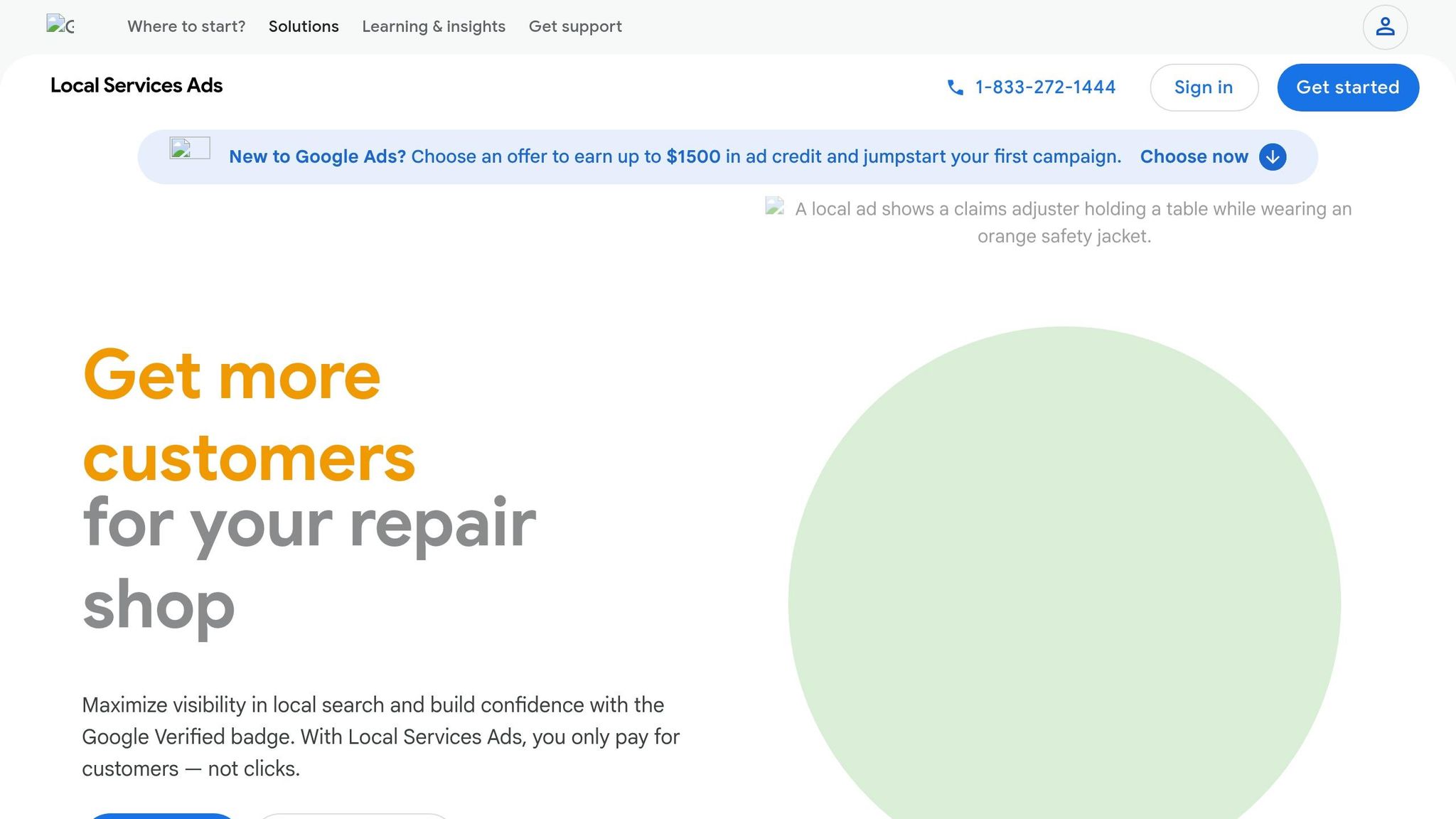
Local Service Ads (LSAs) are a game-changer for DUI attorneys. Positioned at the very top of Google search results - above both traditional PPC ads and organic listings - they’re tailored for urgent, high-intent searches.
The standout feature of LSAs is their pay-per-lead model. Instead of paying for clicks, you only pay when someone contacts your firm through the ad, whether by phone call or text message. This approach makes your spending more predictable and ensures you’re paying for actual leads, not just traffic.
Another major benefit is the "Google Screened" badge. Google verifies your professional license and background before granting this status, which helps build immediate trust with potential clients. Considering that 28.5% of users click on the first result in Google search, and 95% never go past the first page, having top placement is invaluable.
To maximize your LSAs, make sure to optimize your profile. Highlight your expertise in areas like first-time offenses, repeat offenses, or test refusals. Actively manage your client reviews within the LSA profile to stand out from competitors. Since DUI arrests can happen at any time, implementing 24/7 intake ensures you’re ready to respond to calls from LSAs immediately.
"Google Local Services Ads allow you to appear at the very top of those local results with your name, reviews, and Google Screened badge." – Locally Shown
Budgeting for LSAs typically ranges from $3,500 to $7,000+ per month, depending on your market and desired case volume. Plus, you can dispute irrelevant leads - like traffic ticket inquiries - and receive credits, helping you protect your marketing budget.
Tracking Campaign Performance and Measuring ROI
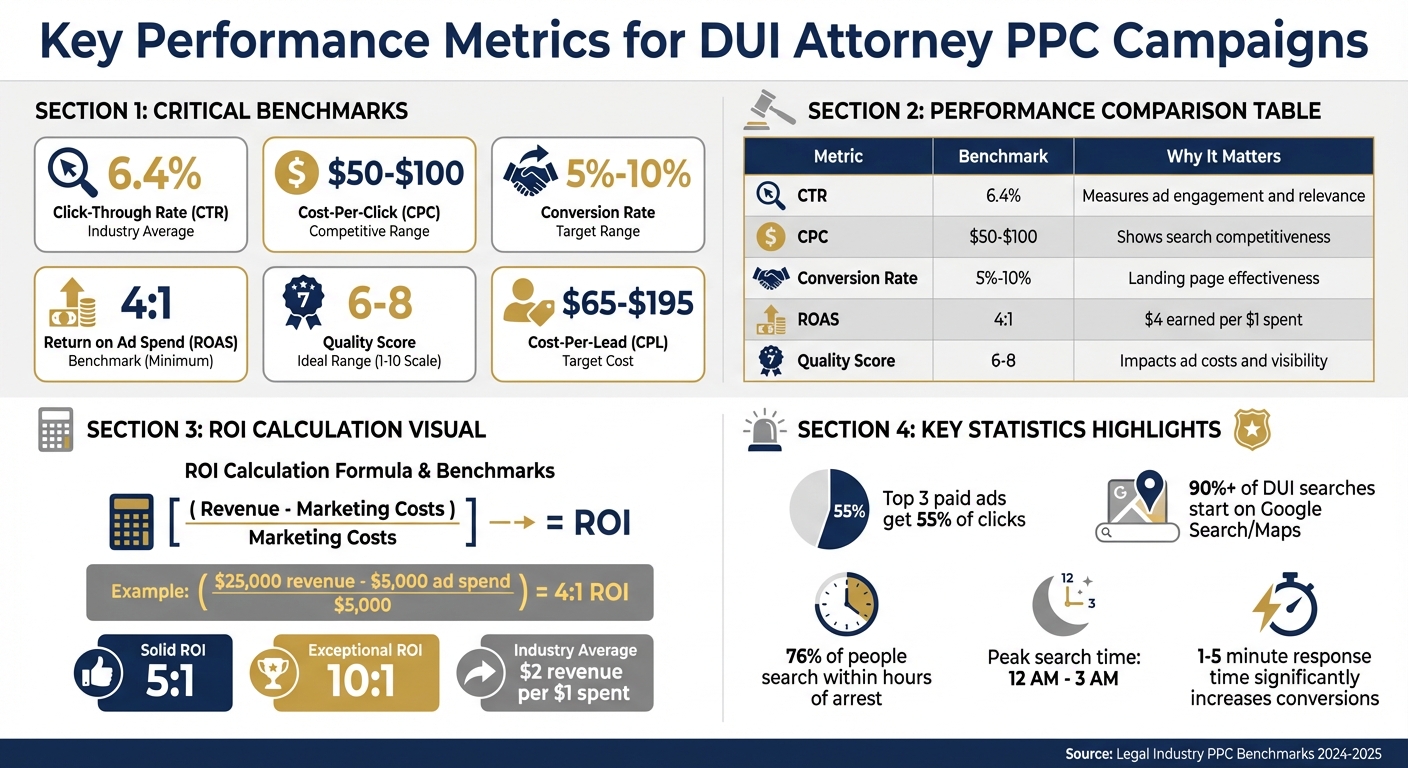
DUI Attorney PPC Campaign Performance Metrics and Benchmarks
Once your campaign is live, it's time to keep a close eye on the metrics that matter most. For DUI attorneys, where the cost per click can range from $50 to $100, understanding which strategies pay off - and which don't - is critical. This means digging deeper than surface-level stats like impressions and focusing on data that directly impacts your revenue.
Key Metrics for DUI Campaigns
To start, focus on Cost-per-Lead (CPL) - the amount spent to generate each inquiry. This is a key indicator of whether your ad spend is sustainable. For criminal defense campaigns, CPL typically falls between $65 and $195, depending on the market. Another important metric is Click-Through Rate (CTR), which measures how well your ads engage users. In the legal industry, the average CTR is about 6.4%.
Equally important is your Conversion Rate, which tracks the percentage of visitors who take meaningful actions, like calling your office or filling out a form. For DUI campaigns, aim for a conversion rate between 5% and 10%. Additionally, your Quality Score - a rating from 1 to 10 assigned by Google - can significantly impact your ad costs. A score between 6 and 8 is ideal. Finally, monitor Impression Share, which shows how often your ads appear compared to competitors, offering insights into your market positioning.
For DUI attorneys, where urgency is often a factor, these metrics are especially critical. Delayed responses or inefficiencies can lead to lost opportunities.
| Metric | Benchmark | Why It Matters for DUI Attorneys |
|---|---|---|
| CTR | 6.4% | Reflects how engaging and relevant your ads are. |
| CPC | $50–$100 | Highlights the competitiveness of DUI-related searches. |
| Conversion Rate | 5%–10% | Shows how effectively your landing pages convert leads. |
| ROAS | 4:1 | Ensures $4 earned for every $1 spent on ads. |
| Quality Score | 6–8 | Influences ad costs and visibility in search results. |
For DUI campaigns, call tracking is essential. Tools like CallRail or WhatConverts can help identify which keywords and ads drive phone calls. Additionally, tracking Cost per Signed Case - linking PPC leads to actual retained clients - can provide a clearer picture of your campaign's success. CRM tools like Clio or Lawmatics make this process seamless. Shifting your focus to these actionable metrics ensures your budget works harder for you.
"PPC is rarely 'set it and forget it.' When your numbers don't add up, it's not a sign of failure – it is an invitation to optimize." - Karin Conroy, Founder, Conroy Creative Counsel
A/B Testing and Campaign Improvements
Testing different ad variations and landing pages regularly can reveal what resonates most with potential clients. Weekly audits are a good practice to spot underperforming elements and reallocate resources to high-performing strategies. For example, ads highlighting specific achievements - like "Over 500 DUI Cases Won" - often outperform generic claims such as "experienced lawyer".
DUI-related searches peak between midnight and 3 AM on mobile devices. To capitalize on this, prioritize mobile-friendly features like click-to-call buttons and ensure your landing pages load in under two seconds. Also, make sure your landing pages match the ad's promise. For instance, if someone clicks on a DUI-specific ad, they should land on a page tailored to DUI cases, not a general homepage.
Case studies show how these strategies can pay off. Philip Kim Law, a Georgia-based DUI firm, partnered with Constellation Marketing in 2025 to revamp its mobile-first website. This led to a 435% revenue increase and an average of 14 new clients per month. Similarly, The Law Office of Valery Nechay in San Francisco implemented a focused landing page strategy, achieving a threefold revenue increase and first-page rankings for over 283 competitive keywords between 2024 and 2025.
Testing trust signals, such as specific case outcomes like "Case dismissed – Blood alcohol level 0.12", against broader success claims can also boost performance. Adding live chat for after-hours lead capture is another effective way to improve conversion rates.
These ongoing adjustments not only refine your campaigns but also ensure your ROI continues to grow.
Calculating ROI and Adjusting Budgets
Once you've identified high-performing metrics, use them to guide your budget decisions. Calculating your return on investment (ROI) is straightforward: (Revenue from marketing – marketing costs) / marketing costs. For instance, if you spend $5,000 on ads and generate $25,000 in revenue, your ROI is 4:1. In legal marketing, a 5:1 revenue-to-cost ratio is solid, while 10:1 is exceptional. On average, Google Ads deliver $2 in revenue for every $1 spent.
To calculate ROI accurately, account for both direct costs (e.g., ad spend) and indirect costs (like software subscriptions or agency fees). Tools like Google Analytics 4 and call-tracking systems can help monitor all conversions, from form submissions to phone calls. Integrating your CRM provides deeper insights, showing which leads convert into paying clients rather than just inquiries.
Armed with this data, you can make smarter budget adjustments. Pause underperforming ads and shift funds to those with higher returns. Use negative keywords - like "free", "public defender", or "penalties" - to filter out unqualified traffic. Increase bids during peak times, such as nights and weekends when DUI searches spike. Fine-tune your geo-targeting to focus on areas near courthouses or jails.
Improving your intake process can also boost ROI. Responding to leads within 1–5 minutes can significantly increase conversions, and even a small improvement in your consult-to-client conversion rate - from 20% to 30% - can raise ROI by 60% without additional ad spend. Using multi-touch attribution gives a clearer view of the customer journey, ensuring you credit all touchpoints, not just the last click.
"Marketing ROI is all about clarity: knowing what drives clients - and what doesn't." - Sasha Perrin, Clio
Conclusion and Next Steps
If you're a DUI attorney looking to run a successful PPC campaign, the key lies in being visible exactly when potential clients are searching for help. With about 76% of people researching lawyers within hours of an arrest, your ads need to dominate the top of search results. Pair that with compelling CTAs and mobile-friendly landing pages, and you'll be ready to capture those urgent leads. The strategies we've covered - like targeting high-intent keywords such as "DUI lawyer near me" and using negative keywords to weed out irrelevant traffic - are all designed to make the most of your ad budget.
Tracking performance is what separates campaigns that drain your budget from those that deliver solid results. By keeping an eye on metrics like Cost-per-Lead, Quality Score, and conversion rates, you can fine-tune your campaign and allocate resources where they’ll have the biggest impact. Combining traditional PPC with Local Service Ads and running call-only ads during peak DUI search hours (especially 12 AM to 3 AM) ensures you're reaching potential clients when they need you the most. With these strategies in place, your campaigns can achieve returns well above industry averages.
Key Takeaways
The foundation of a successful DUI PPC campaign is precision and adaptability. Here’s what you should focus on:
- High-intent keywords: These ensure you’re targeting people actively searching for legal help, not just browsing for information.
- Conversion-ready landing pages: Pages with fast load times (under 2 seconds), clear contact information, and visible phone numbers can turn clicks into actual consultations.
- Strategic ad scheduling: Align your ads with DUI arrest patterns and use 24/7 intake systems to capture leads when others might be offline.
- Performance tracking: Tools like CallRail let you measure cost-per-signed-case, giving you a clear sense of ROI beyond just clicks.
The numbers back this up: the top three paid ads on search results get about 55% of the clicks, and over 90% of DUI-related searches start on Google Search and Google Maps. This means having a strong digital presence isn’t optional - it’s essential. Using negative keywords like "free", "public defender", and "pro bono" helps you avoid wasting money on searches that won’t convert. Revisiting your keyword strategy and ad scheduling regularly will keep your campaign optimized for results.
Getting Started with Surfside PPC
Ready to take your campaigns to the next level? Surfside PPC offers Google Ads management services starting at $500/month, covering everything from conversion tracking and landing page optimization to ongoing campaign adjustments. For those who prefer a more hands-on approach, consulting sessions provide 90-minute deep dives into account audits, keyword research, and strategies tailored specifically for DUI attorneys.
If you’d rather learn at your own pace, the Surfside PPC Google Ads Course is a great option. It covers campaign setup, audience targeting, and performance tracking, making it ideal for building in-house expertise. Whether you go for full-service management or self-guided training, the goal remains the same: turning expensive clicks into paying clients with a data-driven, constantly improving approach.
FAQs
What budget do I need to start Google Ads for DUI cases?
A typical starting budget for Google Ads in DUI cases falls between $10 and $50 per day. The exact amount depends on factors such as your location and the level of competition. This range gives law firms the flexibility to test their campaigns, fine-tune their approach, and track performance for better results over time.
How do I handle leads from 12 AM to 3 AM if my office is closed?
To handle leads outside of regular business hours, implement a 24/7 automated system like a chatbot or AI-powered intake tool. These tools can handle common inquiries and gather essential client information seamlessly. Additionally, take advantage of Google Ads extensions like click-to-call or sitelinks. These features can direct potential clients to helpful resources or a dedicated landing page, ensuring you don't miss out on high-intent leads, even when your office isn't open.
How can I track cost per signed DUI case from my ads?
To measure the cost per signed DUI case, start by setting up conversion tracking in tools like Google Analytics. This will help you monitor key actions such as contact form submissions or phone calls. Implement call tracking to link incoming calls directly to your ads, ensuring accurate attribution.
Once you have this data, calculate your cost per signed case by dividing your total ad spend by the number of signed cases. To better evaluate your return on investment (ROI) and fine-tune your campaigns, consider assigning a monetary value to each lead. This approach gives you a clearer picture of your campaign's effectiveness.