

Click-Through Rate (CTR) is a key factor in determining your Google Ads Quality Score, which directly affects your ad's position and cost-per-click (CPC). Here's the quick takeaway:
- CTR measures how often people click your ad after seeing it. Higher CTR = better ad relevance.
- Quality Score (1-10) depends on expected CTR, ad relevance, and landing page experience.
- A higher Quality Score leads to lower CPCs and better ad placements.
To improve CTR (and therefore Quality Score):
- Write ads that match user intent with clear calls-to-action.
- Use ad extensions like sitelinks, callouts, and images to boost engagement.
- Test multiple ad variations and focus on high-performing ones.
- Optimize your landing page for speed, mobile-friendliness, and relevance.
- Target the right keywords and exclude irrelevant ones.
Bottom line: A strong CTR improves your Quality Score, lowers costs, and increases ad visibility, giving you better results for your ad spend.
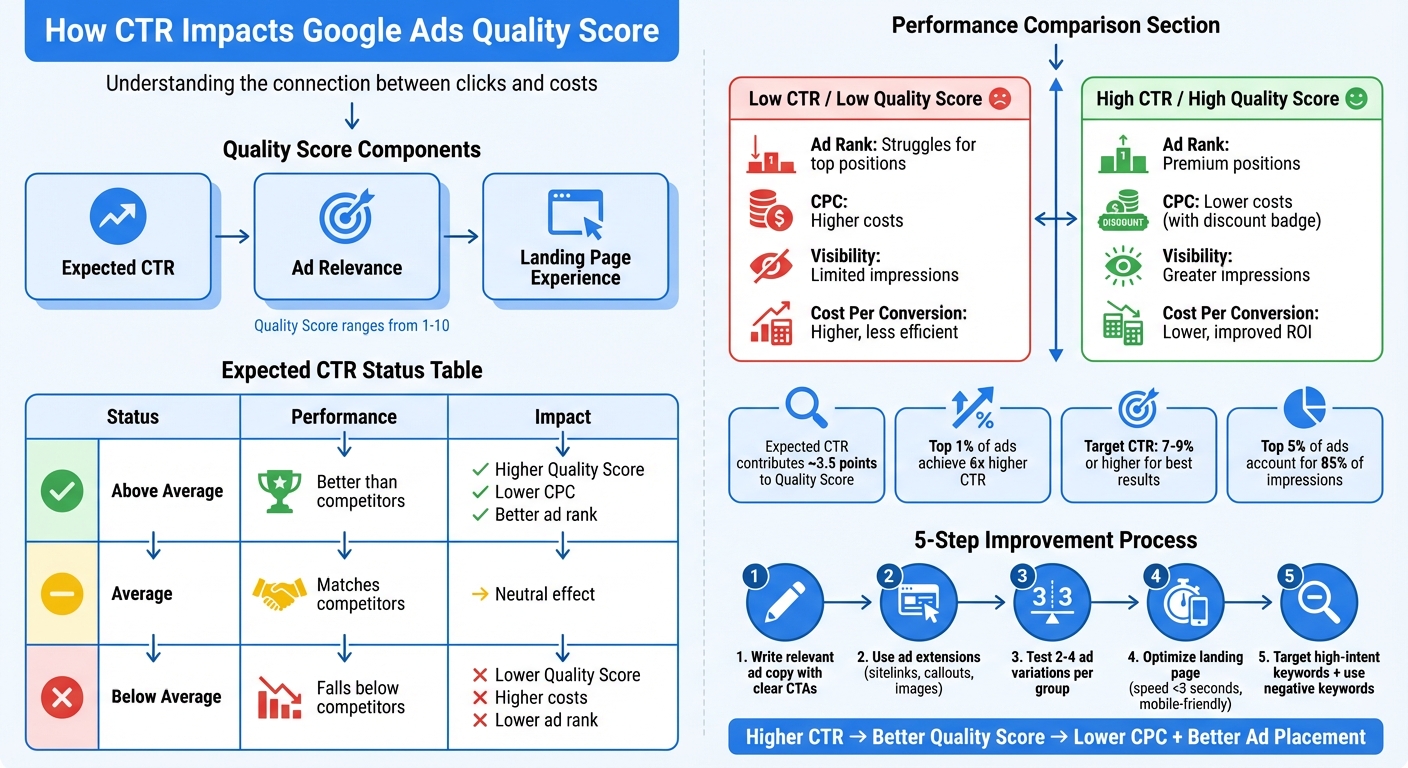
How CTR Impacts Google Ads Quality Score and Ad Performance
How CTR Affects Google Ads Quality Score
Expected CTR and Quality Score
Google predicts the likelihood of your ad being clicked for a specific keyword using historical CTR data. This prediction is called Expected CTR and plays a key role in shaping your ad's performance over time.
To ensure fairness, Google evaluates your keyword's performance against other advertisers bidding on the same search term over the past 90 days. The data is adjusted to remove factors like ad rank and visibility, focusing purely on the relationship between the keyword and the ad. Based on this, your Expected CTR is rated as "Above Average", "Average", or "Below Average." This rating is one of three primary factors determining your Quality Score, which ranges from 1 to 10.
| Expected CTR Status | Meaning | Impact on Quality Score |
|---|---|---|
| Above Average | Performs better than the average for the keyword. | Improves Quality Score, lowers CPC, and boosts ad rank. |
| Average | Matches the average performance for the keyword. | Neutral effect; other factors weigh more heavily. |
| Below Average | Falls below the average for the keyword. | Reduces Quality Score, increases costs, and lowers ad rank. |
This classification shows how closely CTR is tied to your Quality Score.
The CTR and Quality Score Connection
A higher CTR not only improves your Expected CTR rating but also increases your Quality Score. This, in turn, enhances your Ad Rank, making it easier to secure better ad positions at a lower CPC. Kristen McCormick, Senior Managing Editor at WordStream, explains it well:
"The higher your CTR, the higher your expected CTR, and the higher your Quality Score. Higher Quality Score leads to higher Ad Rank. Ads that rank higher get clicked more at lower costs."
Google prioritizes ads with strong CTRs because they generate more clicks, which ultimately benefits Google's revenue.
Additional Benefits of Higher Quality Scores
Beyond cutting costs, a better Quality Score improves ad visibility and optimizes your budget. Ads with high Quality Scores can secure premium positions without requiring higher bids, reducing Cost Per Conversion (CPA) and boosting ROI.
Data shows that the top-performing ads drive the majority of impressions and clicks. For example, the top 15% of ads achieve double the CTR, while the top 1% see six times the CTR. Additionally, the top 5% account for 85% of impressions. By improving CTR and Quality Score, you can reallocate your budget from underperforming ads to campaigns that deliver better results.
| Metric | Low CTR / Low Quality Score | High CTR / High Quality Score |
|---|---|---|
| Ad Rank | Struggles to secure top positions | Easier access to premium positions |
| Cost Per Click (CPC) | Higher; requires more spend for visibility | Lower; benefits from discounts |
| Ad Visibility | Limited impressions; stricter thresholds | Greater impressions; lower thresholds |
| Cost Per Conversion | Higher; less efficient use of budget | Lower; improved ROI on ad spend |
sbb-itb-d8a1e45
How to Improve Google Ads Quality Score (I Hit 10/10 for Hundreds of Keywords!)
How to Improve CTR for Better Quality Score
To boost your CTR and, in turn, improve your Quality Score, try applying these focused strategies.
Write Relevant Ad Copy
Your ad copy should align closely with the user's search intent. For instance, if someone searches for "free shipping sneakers", include that exact phrase in your ad instead of something vague like "athletic footwear deals." The closer the match, the better your Quality Score.
Incorporate the target keyword naturally in your headline and display path. For example, if you're targeting "custom Italian design", your display path could be something like "YourSite.com/Custom-Italian-Design".
It also helps to break large ad groups into smaller, tightly related ones. Instead of stuffing 50 keywords into one group, aim for smaller groups of 5–10 keywords. This way, you can create more specific, tailored ad copy for each search term.
Don’t overlook the importance of a strong call-to-action. Use clear, action-oriented phrases like "Buy Now", "Order Today", or "Sign Up." Highlight specific benefits in your headlines, such as "Free Shipping", "Money-Back Guarantee", or "50% Off Today." Keep your language simple and avoid jargon or abbreviations that could confuse readers.
"Your goal is not to get the highest click-through rate, but the highest qualified click-through rate possible." - Kristen McCormick, WordStream
Once your ad copy is optimized, step up your game with ad extensions.
Use Ad Extensions
Ad extensions (or "assets" in Google Ads) give your ads extra visibility and make them more clickable. These tools can make a big difference:
- Sitelinks: Direct users to specific pages like "Pricing", "Reviews", or "Contact Us."
- Callouts: Highlight perks like "Free Delivery", "24/7 Support", or "Price Match Guarantee."
- Structured Snippets: Organize your offerings into categories like "Brands" or "Styles."
- Promotion Assets: Schedule time-sensitive sales with clear start and end dates.
- Image Assets: Use high-quality product or lifestyle images to grab attention, especially on mobile.
- Price Assets: Display transparent pricing (e.g., "From $X.XX") to appeal to cost-conscious shoppers.
"A proper ad asset setup gives you more real estate on the search results page, more compelling messaging, and best of all, free boosts to your click-through rate." - Daryl Mander, BigFlare
Though ad extensions don’t directly impact your Quality Score, they can significantly increase your CTR, which improves your Expected CTR - a key factor in Quality Score.
Test Different Ad Variations
Constantly testing and refining your ads is critical. Run 2–4 ad variations per group and focus on the ones that perform best. While Responsive Search Ads (RSAs) can mix and match headlines and descriptions automatically, don’t rely entirely on automation. Manually test different approaches. For example, compare emotional messaging like "Boost Your Career" with more practical, feature-focused copy.
Experiment with various calls-to-action. Does "Get a Quote" outperform "Sign Up Today"? Does "50% Off" in the headline drive more clicks than if it’s buried in the description? Use your Expected CTR status (Below Average, Average, or Above Average) to identify underperforming keywords that may need a fresh approach.
Once you know what works, pause low-performing ads and reallocate your budget to the winners.
After perfecting your ad copy, make sure your landing page delivers on the promise.
Improve Landing Page Experience
Your landing page needs to match the expectations set by your ad. For instance, if your ad promotes "Free Shipping on Running Shoes", the landing page should display that information prominently.
Page speed is another critical factor. If your landing page takes longer than three seconds to load, you risk losing visitors. Tools like Google’s PageSpeed Insights can help you identify and fix speed issues. Additionally, ensure your page is mobile-friendly, with easy-to-tap buttons, readable text, and simple forms.
Finally, deliver what you promise. If your ad promotes "beginner yoga classes", your landing page should include class schedules, instructor details, and pricing - without requiring visitors to dig around for this information.
Improve Keyword Targeting
Targeting the right keywords ensures your ads appear for relevant searches. Start with phrase and exact match types to maintain a high CTR, then expand gradually as you identify top-performing variations.
Don’t forget about negative keywords. For example, if you sell premium Italian leather shoes, exclude terms like "cheap" or "knockoff" to avoid attracting the wrong audience. Regularly review your search terms report to find irrelevant queries and update your negative keyword list.
Focus on high-intent keywords that signal readiness to act. For instance, "Buy running shoes online" shows a stronger intent to purchase than "running shoe reviews."
With these strategies in place, you’ll be well on your way to improving CTR and boosting your Quality Score. These foundational improvements set the stage for even greater ad performance.
How Surfside PPC Can Help Boost CTR and Quality Score
Surfside PPC's Google Ads Management Services
Surfside PPC’s monthly management services zero in on the three key factors that directly influence your Quality Score: expected click-through rate (CTR), ad relevance, and landing page experience. With over $1,000,000 in annual Google Ads spend and more than eight years of experience, the team uses tried-and-true methods to improve CTR and maximize ROI.
Their approach includes creating custom campaign strategies, setting up conversion tracking, and ongoing optimization tailored to your business goals. The team crafts ad copy with clear calls-to-action like "Buy", "Sign up," or "Get a Quote" to boost expected CTR. By organizing keywords into tightly themed ad groups, they ensure your ads align perfectly with user search intent.
To refine results further, Surfside PPC employs negative keywords to eliminate irrelevant traffic and optimizes landing pages for mobile-friendliness and fast load times (under three seconds). Founder Corey personally oversees every account, supported by a skilled team that ensures smooth and effective campaign management. This hands-on commitment enhances the technical strategies they implement.
"I believe in Google Ads Management that is transparent, effective, efficient, and honest. We don't want to waste your budget, we want to grow your business."
– Corey, Founder, Surfside PPC
With these tailored strategies, Surfside PPC helps drive higher CTRs and bolsters your Quality Score.
Consulting and Educational Resources
In addition to managed services, Surfside PPC offers 90-minute consulting sessions complete with an in-depth account audit. These sessions identify opportunities to improve expected CTR, ad relevance, and landing page experience. The team provides actionable solutions to boost ROAS, refine audience targeting, and implement best practices.
For those seeking ongoing learning, the Surfside PPC Google Ads Course dives into how to leverage Quality Score to improve underperforming keywords and ads. The course covers advanced techniques like dynamic keyword insertion, thematic keyword grouping, and A/B testing to help maintain strong CTRs and Quality Scores over time. It also teaches methods to reduce wasted ad spend while driving high-quality traffic more efficiently.
"Google Ads is not easy for beginners. However, by following the right strategies you can save $1,000's of your advertising dollars and spend more efficiently."
– Corey, Founder, Surfside PPC
These consulting sessions and educational resources equip you with the knowledge and tools to maintain high CTRs and strong Quality Scores, aligning with the strategies Surfside PPC employs in their managed services.
Conclusion
Click-Through Rate (CTR) plays a key role in determining your Quality Score, which directly impacts both your cost per click (CPC) and ad placement. In fact, Expected CTR alone contributes around 3.5 points to your Quality Score. When your CTR hits 7% to 9% or higher, Google identifies your ads as highly relevant, rewarding you with lower CPCs and better ad rankings.
Achieving a Quality Score of 7 or above indicates that your ad aligns well with Google's relevance standards. This can result in higher ad rankings, more impressions, increased clicks, and a lower cost per acquisition (CPA).
Boosting CTR requires constant fine-tuning of ad copy, keyword selection, and landing pages. The best-performing advertisers - those in the top 1% - achieve CTRs that are six times higher than the average. By consistently optimizing key elements like engaging calls-to-action, ad extensions, and tightly grouped, relevant keywords, you can significantly enhance both your CTR and Quality Score.
For advertisers looking to maximize their results, Surfside PPC offers expert management services and consulting sessions. Their tailored strategies focus on continuous optimization to drive measurable improvements in CTR and Quality Score, ensuring your campaigns deliver real results.
FAQs
How does CTR affect my Google Ads Quality Score, and how can I improve it?
CTR, or click-through rate, is a key factor in your Google Ads Quality Score. It measures how often users click on your ad after seeing it, which signals how relevant and engaging your ad is to your audience. A strong CTR not only improves your Quality Score but can also lead to better ad placements and lower costs per click.
So, how do you improve CTR? Start by crafting ad copy that directly aligns with the keywords you're targeting. Make sure your messaging speaks to what users are searching for and includes clear, attention-grabbing calls-to-action. This increases the likelihood of clicks.
Don’t stop there. Refine your keyword strategy to focus on high-intent search terms - those that show the user is ready to take action. Pair this with landing pages that offer a smooth and engaging experience. Why? Because when users find what they’re looking for quickly and easily, it can positively impact both your CTR and your Quality Score.
Finally, keep testing. Regularly analyze your ad performance and tweak your approach based on the data. Whether it’s adjusting headlines, testing new calls-to-action, or experimenting with different keywords, ongoing optimization is your best tool for consistent growth.
How does landing page experience affect Google Ads Quality Score?
Your landing page plays a big role in shaping your Google Ads Quality Score. A page that's well-designed, relevant, and user-friendly not only boosts ad relevance but also creates a positive experience for anyone who clicks through.
Google looks at several key factors to evaluate your landing page, including:
- Page load speed: Slow-loading pages can frustrate visitors, so speed is crucial.
- Mobile responsiveness: Your page must work seamlessly on all devices, especially smartphones.
- Content relevance: The content should align with the ad and meet user expectations.
- Ease of navigation: A clear, intuitive layout helps users find what they need quickly.
Fine-tuning these elements can improve your Quality Score, which can lead to better ad performance and even lower your cost per click.
Why does Expected CTR matter for my Google Ads performance?
Expected CTR represents Google's prediction of how likely users are to click on your ad when it appears. This metric plays a crucial role in determining your Quality Score, which directly impacts your ad's ranking and how much you pay per click (CPC).
When you work on boosting your Expected CTR - by writing engaging ad copy, using relevant keywords, and crafting persuasive calls to action - you not only improve your ad's performance but also stretch your advertising budget further. It’s a key factor in driving better results and increasing your return on investment (ROI).
0 comments